Tangible steps for transitioning to a solarpunk civilisation.
This website is about practical steps—what we can really do to arrive at a sustainable future within our lifetimes.
My suggested action plan is to pursue a highly specific collection of practical steps: techniques which can be implemented by anyone right now.
Efficient arrangements of matter in spacetime.
To begin with, a list of existing online resources can be found here.
I’ve collected the resources I’ve found which actually explains how to do something in practice. This can be useful because 99% of online resources are junk and empty words. Here, I’ve filtered out the garbage and made a list of useful resources.
A rocket mass heater will heat your house at zero recurring cost, not just in theory but in practice. It can also work as a water heater, cookstove and oven.
The heater is built with a large thermal mass (clay-based, for instance). Heat keeps radiating for more than 24 hours after the fire has gone out, keeping your house comfortably warm overnight.
Rocket mass heaters use a fraction of the fuel that conventional wood stoves use (5 – 10 times less fuel).
They are powerful units which burn extremely hot, incinerating virtually all impurities.
The preferred fuel is small-diameter branches and sticks. You can heat your house with coppiced willow from a wastewater ditch. As the willow uses nutrients from local wastewater to grow, you will be hard-pressed to find a more environmentally friendly heating system.
There’s a good summary of rocket mass heaters on appropedia. Alternatively, there’s a video explanation by Paul Wheaton here. For a bunch of questions and answers, I recommend Matt Walker’s videos.
Air tubes for geothermal energy makes for a passive or semi-passive (many designs require a fan) heating- and cooling system.
Underground systems can be used in a wide variety of climates such as the deserts or the temperate zones.
The most basic system, completely passive with no moving parts, would be to bury a 40 m (≈ 131 ft) long pipe as straight as possible from your house for passive airflow. Closest to your house, it should be 2 m or deeper below ground. Furtherst from your house, it should be 3 m below ground. The pipe should be 15 cm (≈ 6 in) Ø.
The airflow prevents mould, but you can put a rope through the pipe as an additional measure (before covering the pipe with soil). Once a year, tie a vinegar-drenched rag to one end of the rope. Then tie another rope to the rag and pull the rag and new rope through the pipe with the first rope. This prevents mould and leaves a rope in the pipe to repeat the process next year.
Radon build-up is prevented in two ways: 1) the pipe sides are airtight (do NOT use perforated drainage pipe) and 2) there is a constant downwards slope away from the house throughout the entire system (radon gas is heavier than air).
Non-violent communication is a way to think and speak which enables people to connect at the heart.
All living beings have needs. These needs range from basic such as the need for air and physical safety to complex such as the need for intellectual stimuli and expressions.
Nonviolent communication teaches to stop and observe a situation objectively (“in situation x I feel y”). Then it teaches to identify which needs are being compromised in the specific situation. Finally it teaches to express this clearly. This creates a benevolent environment which optimises the chances for a conflict resolution most suitable to both parties.
There’s a three hour long workshop video with the founder Marshall Rosenberg here.
Jean Pain composting (pronounced “jan pae”) utilises the heat from decomposing brushwood. This can be used to heat greenhouses and larger spaces anywhere in the world where brushwood is available.
Chip freshly cut brushwood into a pile. Thoroughly soak the woodchips as they build up. Place an empty hose inside the pile as you build it in order to extract the heat through water circulation once finished.
Jean Pain was able to heat 4 litres of water per minute by 50°C (122°F) for 6 months using a 50 tons heap (source: page 49 of the small book “The Methods of Jean Pain” — here’s a summary of the book). A more practical implementation is to build a much smaller mound with a closed-loop system where the water doesn’t have to be reheated much.
Here are some tips from the book “The Compost-Powered Water Heater” by Gaelan Brown, pages 121 & 130:
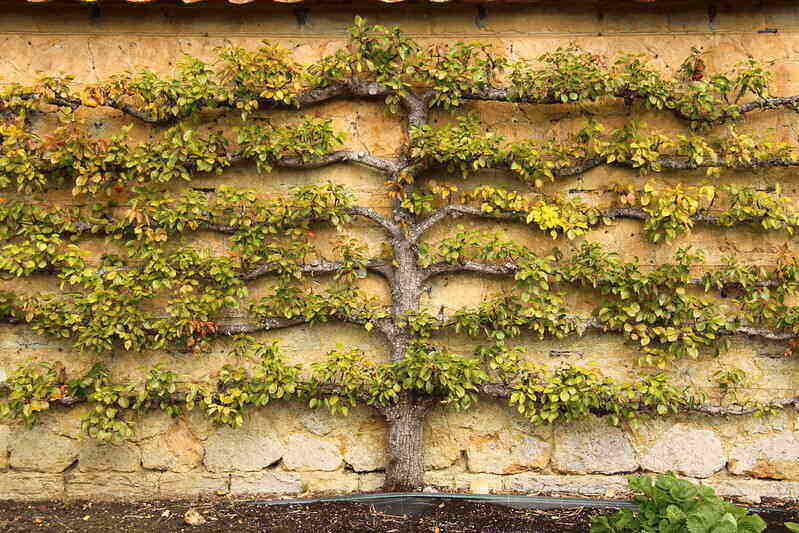
Fruit trees give tremendous yields, and are one of the best examples of a sustainable system:
“A sustainable system is any system which, over its lifetime, produces more energy than it takes to establish and maintain it.” — Bill Mollison, founder of Permaculture
Here are some tips and tricks:
Tree leaf lettuce refers to edible tree leaves used as lettuce.
Leaves will grow without any work from the gardener. On top of this, the tree will grow them using minerals from deep soil layers which none of your other vegetables can reach. Trees are resilient to climate change in unique ways compared to annual vegetables, such as being completely slug resistant. They also provide animal habitat and a number of other benefits.
Here’s a list of tree species with edible leaves:
In order to make tree leaf lettuce palatable, grow perennial, edible succulents such as stringy stonecrop and add them to the tree leaf salad. This provides the crunch we’re used to in regular salads.
These trees are good candidates for tree hay, because leaves edible to humans are also edible to other animals.
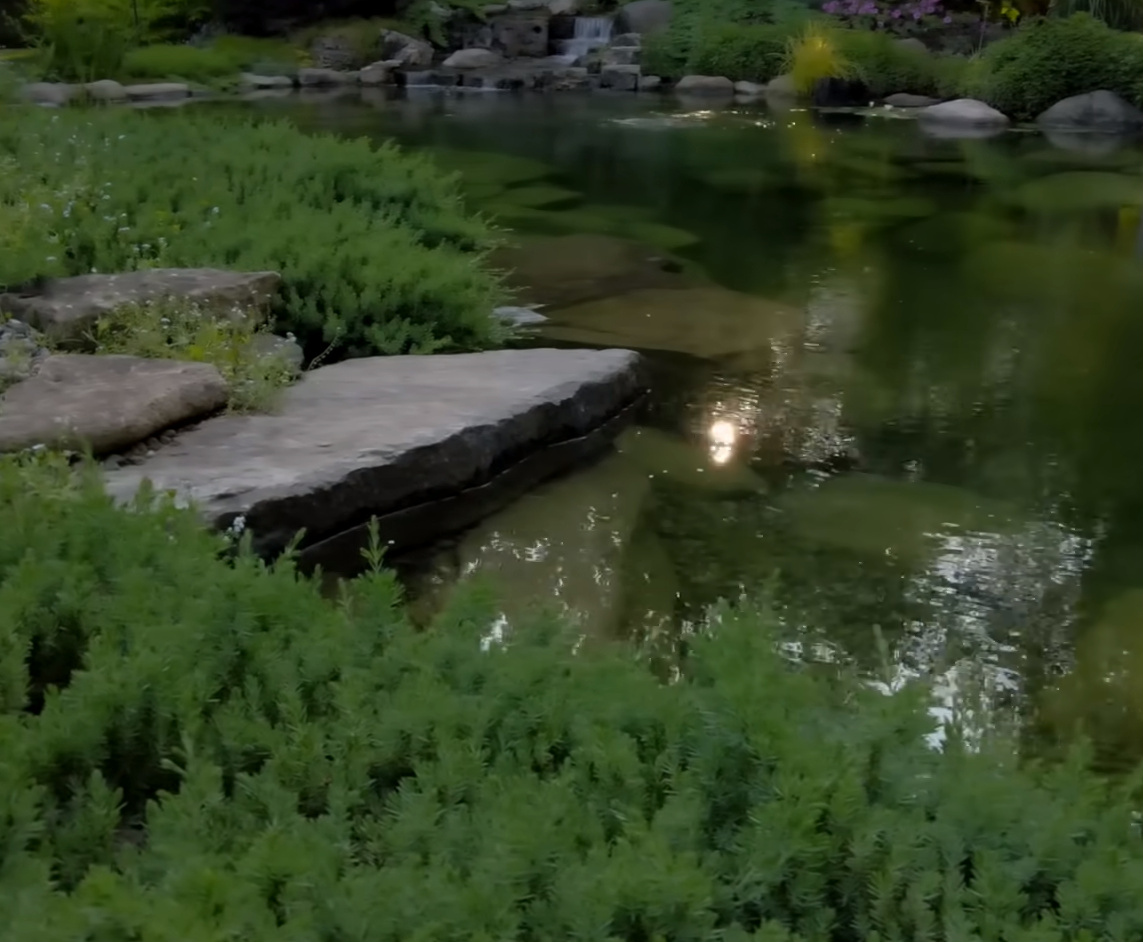
Make ponds without liners. Water has the most impact on creating diverse ecosystems. A pond can also be further developed into a swim pond (covered in the next transition tactic below, click here to scroll down). Dig as large and as many ponds as possible.
To decide where to dig a pond, go outside during a rainfall and note where water naturally accumulates.
I’ll cover four techniques for sealing a pond without a liner: 1) Sepp Holzer’s technique, 2) gleying, 3) puddling and 4) bentonite clay.
Ponds will naturally seal over time due to biofilm buildup clogging gaps between particles, but at a slower rate.
If you don’t already lead the water from your roof into cisterns for harvesting rainwater or into a rain garden, you can instead lead it into a pond. This will make the pond fill up quicker and the seal won’t have to be as watertight.
Ponds are not mosquito havens. Dragonfly nymphs will annihilate mosquito larvae underwater, and dragonflies themselves prey on mosquitoes. Mosquitoes need predator free, standing water to thrive. Dragonflies will naturally show up at properly dug ponds—I have seen it. Birds (many of which eat mosquitoes) and other animals will come to your pond to drink.
If you dislike wasps; don’t, as they hunt aphids to feed their larvae. I’m personally happy to surrender part of my garden to wasps if they grace it with a nest, but for the less tolerant out there, the diversity of a pond seems to keep wasps in check. Wasps have a tendency to tolerate sterile environments better than most other insects—a more diverse environment means that more niches are filled and the wasps are given less space.
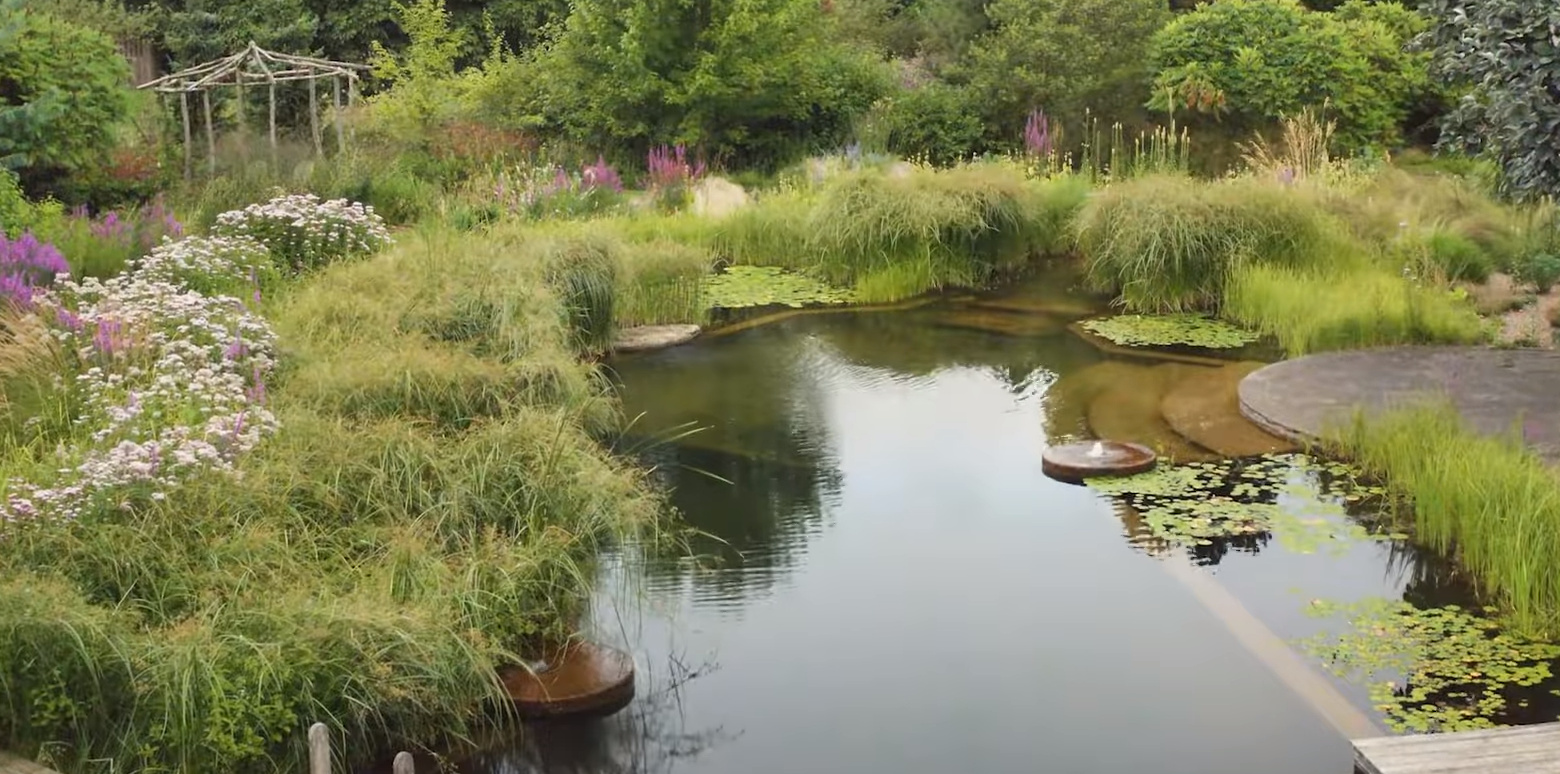
Swim ponds (also natural pools, natural swimming pools or recreation ponds) are ponds built for swimming (example photo of a swim pond — example photo of a recreation pond). They have natural mechanisms for cleaning the water built into them. These ponds are flashy and attractive, granting the opportunity for chemical-free swimming right next to your house on hot summer days. Natural pools (and geodesic dome greenhouses, see below) are also the best eye catchers and conversation starters for naturally introducing neighbours to solarpunk. Even if no words are exchanged, more of these in landscapes will be one step closer to realising solarpunk.
Techniques for improving water quality primarily focus on 1) limiting nitrogen in the pond, 2) limiting phosphorous in the pond 3) reducing sunlight reaching the water and 4) increasing water movement. Water quality worsens when algae grows. Algae depends on sunlight and nutrients. Use multiple water cleaning systems such as:
The previous transition tactic covers how to build ponds without liners (click here to scroll up to that section).
Use the cleaning systems from natural pools combined with aesthetics from both natural pools and recreation ponds. Traditional natural pools looks too ugly. Recreation ponds looks too artificial, especially the landscaping above the waterline. Use only the idea of boulders and shore junipers from recreation ponds. Refrain from introducing man-made objects such as wooden decks or electric lighting. Also avoid trimmed edges, lawns and sterile, uniform plantings.
Recreation ponds use energy and unsustainable elements such as oversized pumps and plastic pond liners. These ponds are also overpriced and sold by slimy entrepreneurs (as can unfortunately be seen in the video in the prior paragraph).
Two shelves of kratky hydroponics will yield one head of lettuce per day indefinitely at the cost of light, fertiliser and seed ($0.04 per head of lettuce for fertiliser and seed).
Total time required for harvesting and replanting is a single-digit number of minutes per week.
Sprouts (image) will yield nutrient-dense vegetables in less than a week anywhere in the world. They require no light to grow and takes less than a minute per day of active work to maintain.
Makerspaces and permablitzes are benevolent gatherings of like-minded radicals where we actually do stuff.
Andrew Sage describes makerspaces here and permablitzes here.
Mutual aid is often encouraged in anarchist spaces. Basically, be generous and build community. This means giving for free at times, lending tools, talking to your neighbours, inviting friends over for dinner etc.
While this is just the pretext, it’s the practical way to make mutual aid happen. Good relationships between people must be there as a baseline for us to fluently help each other.
Not only is this good for everybody, but if people around us get the feeling that we are generous and happy, they will be more inclined to accept or even adapt our ideas themselves in the end.
Andrew Sage generally covers community building and activism well. You can learn about mutual aid from him here.
Permanent raised beds is an excellent way to grow your own vegetables.
The biointensive growing method is a system to densely grow crops for calories (eating) and biomass (compost) simultaneously.
Examples of crops include maize (corn), amaranth, millet, quinoa, chard, chives, root vegetables (potato, sweet potato, carrot, parsnip, Jerusalem artichoke, leek, garlic, black salsify, horseradish, common salsify, taro etc.) and more “standard” home garden crops like lettuce and tomato.
The relevant information is principle 5 and principle 6 (see also .pdf page number 15 & 16 of the “Grow Biointensive” handbook).
Double digging (principle 1) can also be useful to know about. Double dig only if you prepare the growing bed on heavy clay, and ever only once for each bed. The default way to prepare a bed is no-dig like so.
Composting (principle 2) is better done not according to the biointensive method, but by throwing biodegradable material into a pile and then never touching it until it’s soil.
Minimise edges in need of maintenance in landscapes. The methods are:
Edges set up like this will never need trimming and are aesthetic. Combining transition tactics which reduces work will free up your time. Combining tactics for aesthetics will culminate into a beautiful landscape which will better convince people than most spoken words.
An earth cellar (root cellar) lets you store large amounts of food without using electricity.
Dry-stack stones into an arced roof. Put a pipe through the ground to the centre of the cellar floor (explained on page 103 in “Sepp Holzer’s Permaculture”). Put another pipe in a wall at a high point near the roof. Put soil on top of the arced roof and let local plants establish to grow a root barrier against rain.
Never use mortar, cement or liners of any kind. That would be inferior design because it 1) requires reliance on industry and money, 2) increases the need for maintenance, 3) looks aesthetically bankrupt, 4) prevents the final structure to reach natural homeostasis with its surroundings and 5) introduces microplastics in the case of synthetic liners.
There are always exceptions; for instance, a cement pipe, vertically buried, with a lid can act as poor man’s earth cellar if the real one cannot be built right away.
Here’s a simple list of long-storing crops to cover both nutrition and variety of taste:
With an earth cellar, everything mentioned here can be stored without electricity.
For the green leaves, I have given examples of the most cold-hardy vegetables. Layered covering (see below) will allow you to grow them in climates down to any temperature.
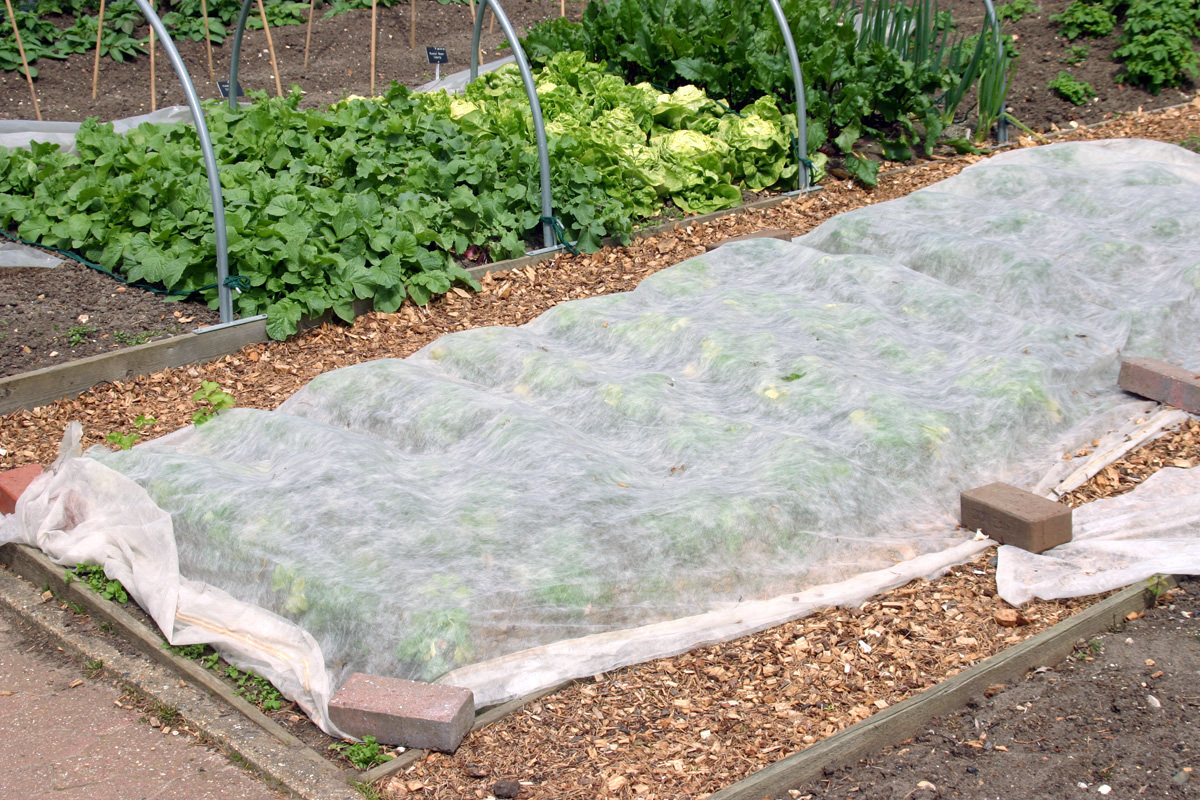
Here’s a list of different types of layered cover to grow plants in cold temperatures. Stacking more layers will allow you to grow/store (depending on latitude) cold hardy plants down to any temperature:
Efficient greenhouses come in a few types: geodesic dome greenhouses, walipinis, house-attached greenhouses (also sunroom, related is conservatory) and Chinese-style passive solar greenhouses.
Most designs orients the greenhouse east-west and heavily insulates the side closest to a pole of the Earth (for the northern hemisphere, north).
The geodesic dome greenhouse is an exception. It compensates by being the most aesthetically pleasing and structurally durable. The dome shape encloses the most space with the least material and is the most wind-resistant. The odd shape also lets it fit where elongated boxes will not.
I have built a 5.6 m (18.37 ft) Ø geodesic dome greenhouse in my garden. You can contact me if you have any questions.
Now comes a list of unconventional housing for people willing to live with less modern comforts.
Some people make unconventional cost-benefit calculations outside of what contemporary society assumes to be reasonable. You can adapt to needing very little money depending on what conventional solutions you choose to forgo or replace. Paradoxically, this can improve a person’s quality of life by freeing them from wage slavery at an assumed “unreasonable” comfort cost which they’re easily willing to pay.
This list is sorted by cheapest housing first to priciest last:
For the cheap homes without plumbing, I recommend Joe Jenkin’s compost toilet. It’s in many ways better than conventional toilets and bidets once you’ve thought it through. For me personally, it took years of being a sceptic before finally allowing space in my mind for deeper reflection. Knowledge of rainwater catchment can also be of use.
Timebanking is a system where members can purchase and offer services. The currency is time and the cost is however long it takes to perform the service. Like tool libraries and repair cafés (see below), timebanks build community and a parallel economy.
Time transactions are tax exempt and completely decoupled from state-issued currency.
Consider starting or participating in a timebank in your area.
Tool libraries are libraries where all sorts of objects are lent, rather than just books. Library hubs can serve a similar function to timebanks (see above) and repair cafés (see below) in ways of building community and a parallel system.
Consider starting or participating in a tool library in your area.
Repair cafés are based on the idea of repairing instead of throwing away. They are similar to timebanks and tool libraries (see above) in being hubs for community and creating a parallel system.
Consider starting or participating in a repair café in your area.
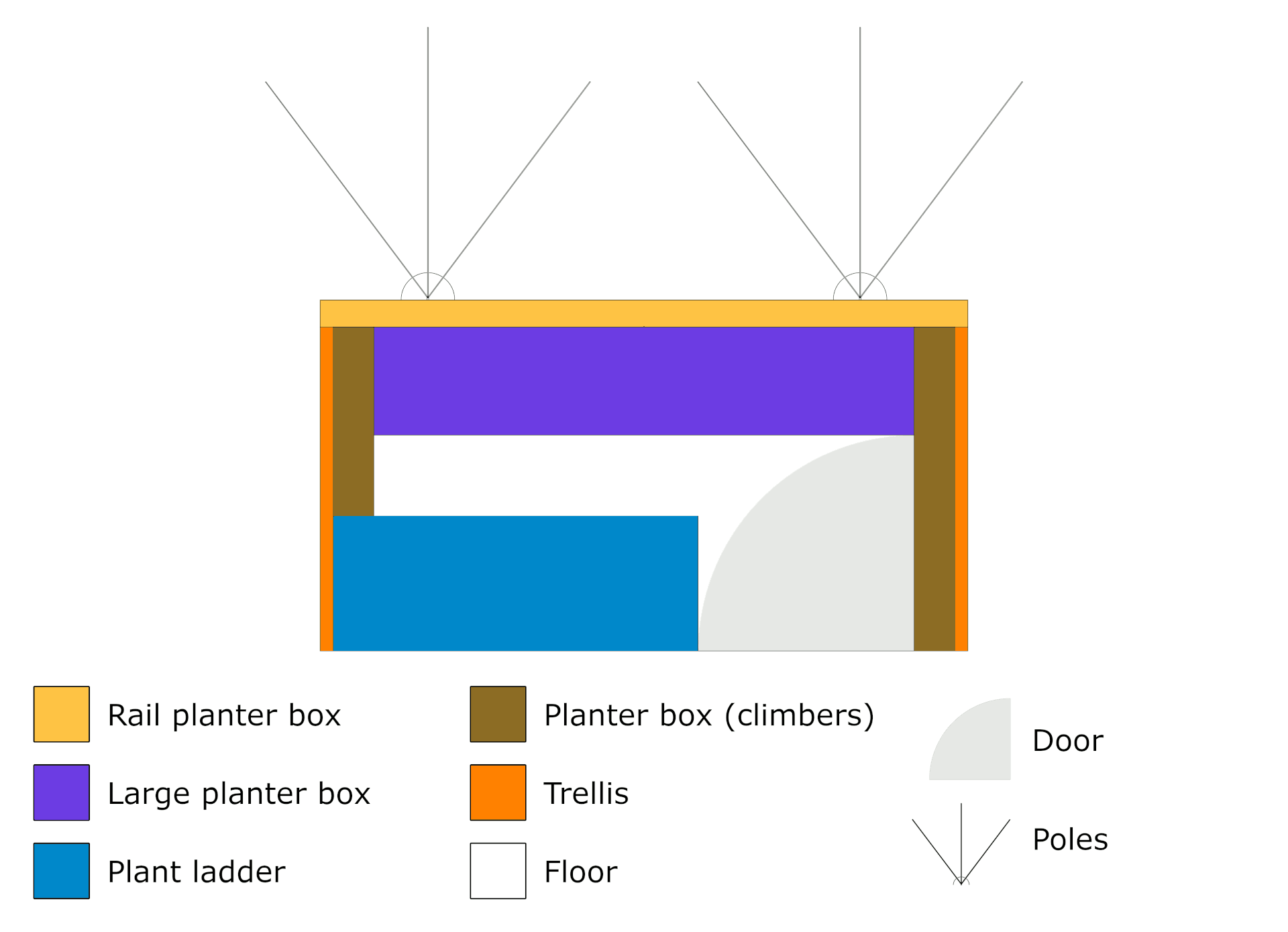
Below is a list of techniques for small space gardening/balcony gardening. Use these together with the plants in the next transition tactic below. I’ve made a balcony layout showcasing how the components in this list can be placed. Here’s the list with components/techniques to maximise yield in small spaces:
Now follows a list of plants for small space gardening/balcony gardening. Use these together with the planters and techniques in the transition tactic above. Many of these plants will re-sprout when cut, making them useful for multiple cut-and-come again harvests. Here’s the list of plants to maximise yield in small spaces:
Grow your own herbs. Many herbs are among the easiest plants to grow. They are also extremely cost- and space efficient.
Pick out three of your favourite herbs and grow large quantities of those. Harvest the whole bunch and hang them to dry. Parsley is stored in the ground.
Carnivorous houseplants of the drosera species can be grown to naturally rid your house of fungus gnats and fruit flies.
My drosera capensis ‘alba’ completely annihilates fungus gnats. This is a good solarpunk and permaculture solution which doesn’t involve disposable products.
Three quick tips on this: 1) take leaf cuttings, 2) a plastic pot with sphagnum moss works best and 3) if you have a clothes dryer, you can use distilled water from it to water carnivorous plants.
Tiny forests are quickly established with the Miyawaki Method—10 times faster than regular forests (introduction videos / in-depth how-to videos).
These forests can be scaled down to grow in as little space as 4 m × 3 m (9.84 ft × 13.12 ft). This makes them suitable to urban areas and even personal gardens.
A delivery bicycle (also utility bicycle, cargo bike, butcher’s bike or Deutsche Post bicycle) can be an excellent investement if the infrastructure is decent where you live.
Make a padded egg box if you want to transport your groceries.
Deep mulch gardening (also Ruth Stout gardening or Back to Eden gardening) essentially means adding a thick layer of mulch on soil. This can be any suitable organic material such as straw, woodchips or leaves. In order to plant, simply make a hole through the mulch down to the soil and plant there.
There are several advantages to this method: work is minimised, soil microbiology thrives under the mulch, weeds cannot grow when the mulch is thick enough to block out the sunlight, there’s an automatic inflow of fertilised new soil due to the mulch breaking down, plants have a slight protection against frost, moisture is retained under the mulch, evaporation is minimised, it’s easier to grow and harvest tubers etc.
Some disadvantages include slug habitat and the need for a source of mulch.
The deep litter method is an elegant way to keep animals comfortable over winter.
A Stirling engine can be used to generate electricity from a fireplace.
I live in Sweden at the latitude of Stockholm (about 59° north), where 5 kW worth of solar panels, about $10 000 worth of solar panels, generates a measly 1000 Watt-hours per day in midwinter. This is so little electricity that no machines bigger than a laptop can be ran. No washing machine. No freezer. Nothing.
Solar panels are still the best option for the majority of the year, but to have any energy consumption beyond a laptop in midwinter, alternative electricity sources are required. An engine at a few hundred W would be useful. There have been attempts at commercial development of engines at 1000 W.
We need innovation to get quiet and powerful Stirling engines. They could be installed on top of any stove to generate the majority of electricity for the darker months in places with little sunlight.
Thermoelectric generators (TEGs) generate electricity from heat differentials and fills a role similar to Stirling engines (see above).
There exists commercial units at 100 W, which can act to generate supplemental electricity from a fireplace in the winter.
The main drawbacks are low efficiency and the need for continuous cooling. The main strengths are straight-forward conversion of heat to electricity and the absence of moving parts (apart from the cooling system).
Universal basic income (UBI) is a small income, sufficient for necessaries, given to all whether they work or not. Managing a UBI is one of the few ways government can be useful during a temporary transition phase.
In the paper “The Cost of Basic Income: Back-of-the-Envelope Calculations”, the cost of a basic income for the USA is explored. The payout is set to $12 000 per adult per month and $6 000 per child per month. The cost of this basic income is estimated at $539 billion per year.
Here’s a quote from the paper above: “This UBI would drop the official poverty rate from 13.5% to 0%, eliminating poverty for 43.1 million people (including 14.5 million children)”. An often cited study on poverty cost in the United States, “Estimating the Economic Cost of Childhood Poverty in The United States”, estimates the yearly cost of childhood poverty alone to about twice that of basic income—little over one trillion dollars.
Basic income would likely pay for itself many times over, unlock human potential and transform how we see work.
The action point here is to advocate in unison for basic income whenever the opportunity presents itself. Theoretically you can also get a tiny cryptocurrency UBI from various projects right now, but it generally seems unviable yet. Be on the lookout, though. Any decent basic income initiative has transformative repercussions.
Minimise economic activity wherever possible. We must all participate in the economic system to some degree, and we’re all in different situations. Go through what you spend money on and seriously consider cutting out each thing.
Make long-time purchases when possible. Buy a cast-iron skillet. Cancel a subscription. If you have to purchase a new cellphone, consider a Fairphone. Grow a small portion of your own food. Occasionally or regularly cook one week’s worth of moussaka or stew in a single go (if you want to take this a step further, use a haybox).
If enough people behaved like this, the economic system would grind to a halt. To make this effective, there needs to be a loud expression coupled with this: show others that your living is good and enjoyable. Politicians will then have to consider a shift in public opinion with their next move. Political leaders never lead—they always follow.
Aesthetics is my favourite topic, so I have put it last and will spend some extra time on an article. I will link the article here when it’s ready.
My subjective take is that the easiest guideline for a beautiful landscape is to shy away from anything with even a slightly mass-produced look. For instance, rock is better than cement, but the rock must not have been cut by industry machinery—a soulless material instantly exposes itself.
Aesthetics have functional importance even though many don’t think so, because they will invoke different feelings which will affect people’s mindsets and actions.
You can check out the aesthetics section under “Vision” if you’re interested in the reasoning.
I’m considering writing longer articles for some points, explaining benefits and steps in greater detail.
I’m also pondering whether it’s worth addressing common misconceptions and talking points. I’m expecting my audience to be quite advanced. At the same time, internet spaces have fostered shallow counter-culture across the board. Strawman arguments and logic-chopping fallacies delivered convincingly are generally blown out of proportion. Thought-terminating reasoning is easy to digest.
Please trust that every transition tactic have had the common criticisms looked into before being added to the list.
As a specific example, indoor farms are discouraged on a general level due to energy for artificial lighting and plastic being too prominent issues. However, exceptions and fringe use cases almost always exists.
When I suggest kratky hydroponics for instance, it’s in the specific context of people’s homes. This is valid because 1) local lettuce eliminates transportation, 2) children seeing how their food grows is an invaluable benefit, 3) if the most accessible alternative to people right now is to purchase supermarket lettuce, it’s generally better that they start their own hydroponic shelf (which have less issues) and 4) in some places, containers can be sustainably built using local bamboo if desired.
A final note is that this list is currently incomplete. I can add hundreds of transition tactics. I will keep adding to the list when I have the time.
Stay tuned!
“The best way to predict the future is to invent it.”
— Alan Kay